In 1975, the same year Taco Bell opened its 500th location, Esperanza Morales was teaching her granddaughter how to make mole negro in a cramped kitchen in East Los Angeles. The recipe involved twenty-eight ingredients, three days of preparation, and techniques that Esperanza's own grandmother had learned in Oaxaca a century earlier.
No cookbook contained this recipe. No restaurant served anything close to it. And as Tex-Mex chains spread across America, convincing millions that Mexican food meant hard taco shells and processed cheese, women like Esperanza quietly kept the real thing alive in their home kitchens.
The Great Substitution
While America was discovering "Mexican" food through Glen Bell's simplified interpretations and Old El Paso's canned sauces, something remarkable was happening in Mexican-American households across the Southwest. Grandmothers who had immigrated decades earlier were passing down cooking knowledge that bore no resemblance to what most Americans thought of as Mexican cuisine.
These weren't the streamlined recipes that could work in restaurant kitchens. They were labor-intensive, regionally specific techniques that required ingredients you couldn't find in regular grocery stores and skills that took years to master.
Consider the difference between restaurant "refried beans" and frijoles de olla as prepared by Dolores Huerta's mother in Stockton, California. The restaurant version: canned pintos mashed with lard and salt. The home version: beans slow-cooked with epazote, onion, and a specific variety of chile that had to be sourced from specialty vendors who imported them from particular regions of Mexico.
Or take masa. While Taco Bell was perfecting the hard taco shell made from processed corn flour, women like Carmen Delgado in San Antonio were still nixtamalizing whole corn kernels with cal (lime), grinding them by hand, and fermenting the masa for days to develop the complex, slightly sour flavor that characterizes authentic tortillas.
The Underground Curriculum
This knowledge survived through what food anthropologist Dr. Jeffrey Pilcher calls "kitchen apprenticeships"—informal teaching relationships between older and younger women that operated completely outside the cookbook-and-cooking-show culture that was shaping mainstream American food.
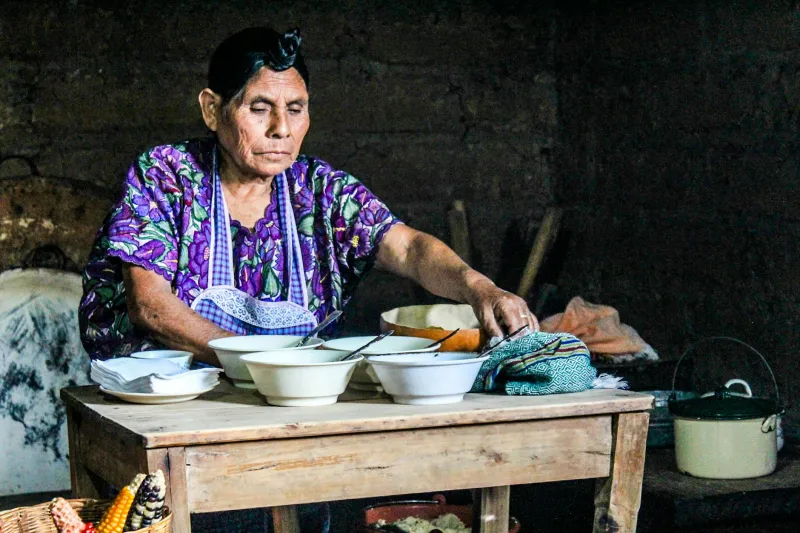
The teaching happened during holidays, family gatherings, and weekend cooking sessions where techniques were demonstrated rather than explained. Esperanza Morales never wrote down her mole negro recipe because the knowledge wasn't meant to be codified—it was meant to be embodied through practice and repetition.
"My grandmother never measured anything," recalls Rosa Gonzalez, whose family moved from Michoacán to Chicago in the 1960s. "She'd say 'enough salt' or 'until it tastes right,' and you had to learn by watching her hands, tasting constantly, understanding how the color changes when you've toasted the chiles long enough."
These informal networks preserved not just recipes but entire food systems: which markets sold the right kind of dried chiles, how to tell when masa had fermented properly, which families in the neighborhood still made chorizo the old way.
What Was Nearly Lost
By the 1990s, food researchers began realizing how much knowledge was disappearing. The women who had learned traditional techniques in Mexico were aging, and their American-born children and grandchildren were often more familiar with Tex-Mex restaurant food than with their own family traditions.
Dr. Maribel Alvarez, who runs the Southwest Foodways Alliance, started documenting these home cooking traditions in the early 2000s and discovered techniques that had never been written down anywhere. She found women who knew how to make mole coloradito (a red mole from Oaxaca that requires roasting chiles until they're almost black), chiles en nogada with walnut cream made from scratch, and dozens of regional salsas that used indigenous ingredients like chilhuacle peppers and hoja santa.
"We were documenting culinary knowledge that was disappearing faster than we could record it," Alvarez explains. "These weren't just recipes—they were entire systems of flavor and technique that connected families to specific places in Mexico."
The Rescue Mission
Today, a small but growing movement of chefs, food writers, and community organizers is working to document and preserve these traditions before they disappear entirely. Organizations like the Heirloom Corn Project in Arizona are connecting traditional home cooks with younger chefs who want to learn authentic techniques.
Chef Pati Jinich, whose PBS show "Pati's Mexican Table" focuses on regional Mexican cooking, spent years learning from home cooks like Esperanza Morales. "The knowledge these women carry is irreplaceable," she says. "They understand flavor combinations and cooking techniques that you can't learn from books or cooking school."
Restaurants like Guelaguetza in Los Angeles and Suerte in Austin are finally bringing some of these authentic traditions to wider audiences, serving moles that take days to prepare and using heritage corn varieties that most Americans have never tasted.
Beyond the Yellow Cheese
What's striking about these preserved traditions is how little they resemble the "Mexican" food that most Americans grew up eating. Real Mexican cooking is regionally diverse, ingredient-driven, and technically complex in ways that Tex-Mex never attempted to capture.
The mole negro that Esperanza Morales taught her granddaughter includes ingredients like chilhuacle negro peppers, Mexican chocolate, plantains, and sesame seeds—combined in a way that creates a sauce with layers of flavor that unfold over several minutes of tasting. It's the kind of culinary sophistication that makes Taco Bell's "Mexican Pizza" seem like a completely different cuisine.
Which, of course, it is.
The women who kept these traditions alive weren't trying to make a political statement about authenticity versus commercialization. They were simply cooking the food they knew how to cook, passing down knowledge the way their mothers and grandmothers had passed it down to them.
But in doing so, they preserved something irreplaceable: proof that Mexican cuisine is one of the world's most sophisticated culinary traditions, not the simplified fast-food version that America fell in love with. Thanks to their quiet dedication, that knowledge is still alive—barely—waiting for a new generation to rediscover what real Mexican food actually tastes like.