The Butcher Shop Secrets Immigrant Families Brought Over — And American Grocery Stores Still Haven't Figured Out
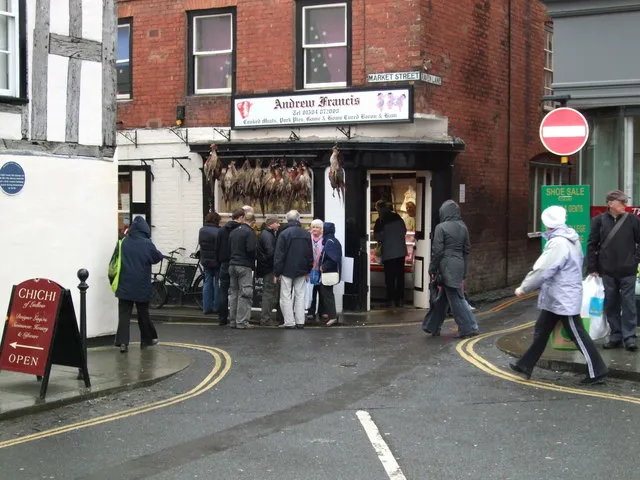
Photo: William Pugh, CC BY-SA 2.0, via Wikimedia Commons
The Butcher Shop Secrets Immigrant Families Brought Over — And American Grocery Stores Still Haven't Figured Out
Walk into a standard American grocery store and ask the person behind the meat counter for a bavette steak, a secreto, or a flat iron cut from the chuck — the real one, not the shoulder tender they sometimes relabel. There's a decent chance you'll get a blank stare. Ask for beef cheeks or pork collar or lamb neck and you might get directed to the dog food aisle.
Now walk into a small butcher shop in a neighborhood with a strong Italian, Mexican, or Argentinian community. Suddenly those cuts appear. Suddenly the person behind the counter knows exactly what you're talking about — and probably has an opinion about the best way to cook it.
That gap didn't happen by accident. It's the result of over a century of diverging butchery philosophies, and the story of how it happened is one of the most flavorful untold chapters in American food history.
Two Ways to Take Apart an Animal
When the American meatpacking industry industrialized in the late 1800s — driven by the massive Chicago stockyards and companies like Swift and Armour — it standardized a particular way of breaking down beef, pork, and lamb. The goal was efficiency and uniformity. Cuts needed to be easy to portion, easy to package, and easy for any butcher in any store across the country to replicate identically.
That standardization produced the cuts most Americans grew up with: T-bones, ribeyes, New York strips, chuck roasts, pork chops. Clean, recognizable, consistent. And it quietly discarded or redirected everything that didn't fit neatly into that system.
 Photo: New York, via as1.ftcdn.net
Immigrant butchers arriving from Italy, Spain, Germany, Argentina, Mexico, and Portugal brought entirely different frameworks. In those traditions, the philosophy wasn't uniformity — it was totality. Every part of the animal had culinary value, and the skill of a butcher was measured by how little went to waste and how cleverly each section was prepared.
"The American system optimized for appearance and portion control," says meat educator and butcher Adam Danforth, author of several books on whole-animal butchery. "Traditional European and Latin American butchery optimized for flavor and economy. Those are fundamentally different goals, and they produce fundamentally different results."
The Cuts That Got Left Behind
Consider the secreto — a thin, intensely marbled cut from the Iberian pig's shoulder blade area, prized in Spanish cuisine and virtually unknown in American supermarkets until about a decade ago. Or the bavette, a French cut from the flank region that has more beefy flavor per square inch than a ribeye but was routinely ground into hamburger in American processing plants because it didn't present well in a display case.
Italian butchers in cities like New York, Philadelphia, and Chicago were selling pork collar — the neck and shoulder muscle — to their communities long before American food media discovered it. It's one of the fattiest, most richly flavored cuts on a pig, perfect for slow-roasting or curing into the Calabrian salume called capicola. American processing simply ground it or folded it into sausage.
Beef cheeks are another example. In Mexican cuisine, barbacoa made from beef cheeks — slow-cooked until they fall apart in deeply savory, gelatinous shreds — is one of the great taco fillings in the world. For most of the 20th century, American meatpackers sold beef cheeks almost exclusively to pet food manufacturers because the mainstream market had no use for them. Mexican butchers in Texas, California, and Chicago were buying up those cheeks for almost nothing and turning them into something extraordinary.
The Neighborhood Shops That Kept the Knowledge Alive
The immigrant butcher shops that dotted urban American neighborhoods from the 1890s through the mid-20th century were doing something that went well beyond selling meat. They were preserving an entire culinary vocabulary.
In South Philly's Italian Market, butchers were breaking down whole pigs in ways that produced cuts their customers recognized from the old country — cuts that came with specific recipes attached, specific memories, specific occasions. A grandmother picking up a piece of pork jowl for her guanciale knew exactly what she was getting and why. The butcher knew too.
 Photo: South Philly's Italian Market, via www.visitphilly.com
Those relationships between butcher and customer encoded a huge amount of food knowledge. The butcher was part cooking teacher, part historian, part community anchor. And when those neighborhood shops began closing in the 1970s and 1980s — squeezed out by supermarket chains that carried pre-packaged, centrally processed meat — that knowledge started disappearing with them.
"When the neighborhood butcher went away, we didn't just lose a store," says culinary historian Hasia Diner, who has written about immigrant food culture in America. "We lost a whole educational system about how to cook."
The Quiet Comeback
Here's where things get interesting again. Over the last fifteen years or so, those forgotten immigrant cuts have been staging a slow but unmistakable comeback — and the people leading the charge are often chefs who traced the knowledge back to its source.
Flat iron steaks, which come from the shoulder blade and were largely ignored by mainstream butchers for decades, are now widely available. Beef cheeks appear on tasting menus at serious restaurants. Pork collar — rebranded as "coppa" or "pork neck" — shows up at whole-animal butcher shops in cities across the country. The bavette has been quietly reintroduced in steakhouses that want to offer something with more character than a standard strip.
Specialty butcher shops with whole-animal programs have been opening in American cities at a steady clip, and many of them are explicitly drawing on immigrant butchery traditions. Places like Fleisher's in New York, Belcampo in California (before it closed), and La Carne in Chicago have built entire business models around the idea that the mainstream American meat counter left a lot of flavor on the table.
Farmers' markets have helped too. Small-scale ranchers who raise heritage breed animals often sell directly to customers, and those customers — increasingly educated by food media and cooking shows — are asking for cuts that supermarkets still don't stock.
What Your Grocery Store Is Still Getting Wrong
The frustrating reality is that despite all this renewed interest, the average American supermarket meat counter still operates on essentially the same industrial logic it did in 1955. The cuts that require customer education don't move fast enough to justify shelf space. The economics of high-volume retail favor predictability over variety.
Which means the best route to those forgotten cuts is still often the same route it's always been: find the butcher shop in the neighborhood that's been there for forty years. The one with the hand-lettered sign in the window. The one where the person behind the counter asks what you're making before they reach for the knife.
The immigrant butchers who carried those traditions across an ocean were onto something the industrial meat system never fully grasped. Flavor lives in the parts that are hardest to standardize. And the cuts that got left behind are still, quietly, some of the best things you can put in a pan.