The Booth Built for Dozing: When American Eateries Charged You to Sleep It Off
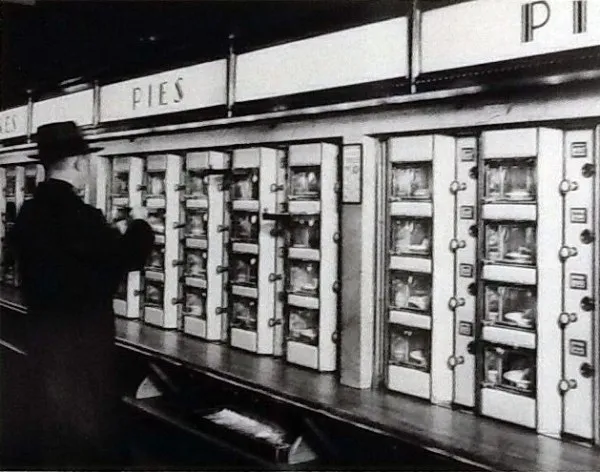
Photo: vintage 1920s automat cafeteria curtained booth interior black and white, via restaurant-ingthroughhistory.com
Picture this: it's 1923, you've just worked a double shift at the cannery, and you stop into the automat for a slice of pie and a sandwich. You finish. You're exhausted. And instead of stumbling home, you slide your dime into a slot, step into a curtained booth, and close your eyes for thirty minutes. Nobody stares. That's the point.
If that scenario sounds made up, you're not alone — most people have never heard that 'rest counters' and napping booths were once a genuine, if modest, feature of American eating establishments. But dig through early twentieth-century trade journals and newspaper classifieds, and the evidence keeps surfacing.
The Golden Age of the Public Nap
The trend had two hotspots. The first was the big-city cafeteria and automat culture of the 1910s through 1930s, where working-class patrons — many of them shift workers or newly arrived immigrants living in crowded boarding houses — needed somewhere to rest between jobs. A handful of lunchrooms advertised 'quiet rooms' and reclining booths right alongside their coffee and pie. For a nickel or a dime, you got a shaded cubicle, sometimes with a cushioned bench wide enough to lie down on.
The second hotspot was the roadside tea room and motor court café of the 1920s and '30s. As Americans took to the highway, long drives became genuinely punishing — no air conditioning, no power steering, roads that turned to mush in the rain. Savvy roadside operators figured out that a tired driver was a dangerous driver, and a few began advertising napping rooms out front. Park the car, pay a small fee, sleep for an hour, wake up and have dinner. Some tea rooms in the Midwest and along Route 66-era corridors reportedly made a tidy side income from exhausted families simply passing through.
It wasn't seen as strange, either. The same era gave us 'rest cures' prescribed by actual doctors, and railroad drawing rooms had long doubled as places to stretch out. Napping in semi-public was simply part of how Americans moved through a hard-working day.
So What Killed It?
Historians point to a perfect storm of boring culprits. The interstate highway system, completed in stages through the 1950s and '60s, made long drives faster and smoother — the desperate nap stop became less necessary. Motels multiplied, giving travelers a proper bed for ten dollars. And urban lunch counters, squeezed by labor costs and shrinking real estate, couldn't justify devoting square footage to a booth that might earn thirty cents a day.
But there's a cultural shift underneath the economics. After World War II, sleeping in public started to read as laziness rather than practicality. The lunch counter that sold rest was out of step with a country in love with hustle. By the 1970s, the napping booth was essentially extinct — surviving only as a vague memory in a few oral histories and the occasional photograph of a curtained automat alcove that modern viewers assume was a phone booth.
Why This Story Hits Different Right Now
Here's the kicker: the rest of the world is circling back to the idea. Japan's 'inemuri' culture — napping in public as a sign of diligence, not weakness — has produced café nap services where you pay by the half hour to doze in a comfy chair. Berlin and Madrid have sleep cafés. Corporate nap pods, once mocked as Silicon Valley excess, are now standard at a growing number of US offices. NASA studies on pilot fatigue gave the practice scientific cover years ago; the culture is only now catching up.
Which makes those curtained automat booths look less like a quirk and more like an idea America abandoned about sixty years too early. We built a whole infrastructure of rest-while-refueling, then tore it out, then spent decades wondering why everyone is exhausted.
The Next Time You're Dead Tired at a Diner
No, your local Waffle House isn't about to install nap booths. But the story is a useful reminder that the rules about where and when it's acceptable to rest are just that — rules, written by one particular era, and changeable by another. A handful of independent US coffee shops have already started experimenting with 'rest chairs' and quiet rooms, usually without much fanfare.
The napping counter never got a proper obituary. Maybe it doesn't need one — maybe it just needs a comeback.