Adam and Eve on a Raft: The Wildly Creative Kitchen Slang That Ran America's Diners for a Century
Adam and Eve on a Raft: The Wildly Creative Kitchen Slang That Ran America's Diners for a Century
Imagine you're a short-order cook in a packed Chicago lunch counter, 1938. It's the noon rush. Orders are flying. The counter is full, the grill is screaming, and your waitress just hollered something that would sound completely unhinged to anyone outside that kitchen: "Adam and Eve on a raft — wreck 'em! Burn one, drag it through Georgia, and axle grease on the side!"
You don't miss a beat. Two scrambled eggs on toast, a chocolate milkshake, a hot dog with mustard, and a side of butter. Coming right up.
This was American diner slang — a living, breathing, wildly inventive spoken language that short-order cooks and waitstaff developed organically across the country over more than a century. It was funny, it was efficient, and it was genuinely brilliant as a management system. And it's almost completely gone now.
How the Code Actually Worked
Diner slang wasn't invented in any one place or by any single person. It evolved the way all great vernacular does — through necessity, repetition, and a whole lot of personality.
The lunch counter environment was uniquely chaotic. A short-order cook might be managing a grill, a fryer, a toaster, and a coffee urn simultaneously while processing a dozen overlapping orders in their head. Written tickets helped, but in a fast-moving counter setup, shouted shorthand was faster. The slang that developed served a very specific operational purpose: it let waitstaff communicate orders quickly across a noisy room while keeping the kitchen moving without a single piece of paper changing hands.
But it did something else too. It created a shared culture, a kind of insider identity that made the grinding work of a lunch counter feel like belonging to something. Knowing the code meant you were part of the crew.
Some terms were purely descriptive in a roundabout way. "Burn one" meant a well-done burger — the visual was obvious. "Drag it through Georgia" meant add mustard, a nod to the South's love of the condiment. "Paint it red" meant add ketchup. "Axle grease" was butter, because, well, look at it.
Others were more theatrical. "Adam and Eve on a raft" — two poached eggs on toast — required you to know both the visual metaphor (the eggs floating on the toast like figures on a boat) and the modification code: "wreck 'em" meant scrambled, "on a raft" meant on toast, "let 'em swim" meant no toast at all.
"Two dots and a dash" was a specific order: two fried eggs and a strip of bacon. "Whiskey" meant rye bread. "Nervous pudding" was Jell-O, which genuinely wobbles under pressure. "Eighty-six" — still used today — originally meant the kitchen was out of something, possibly derived from old slang for a grave's depth, or maybe from a New York bar that cut off regulars at that number. Nobody agrees on the origin, which is very on-brand for this whole tradition.
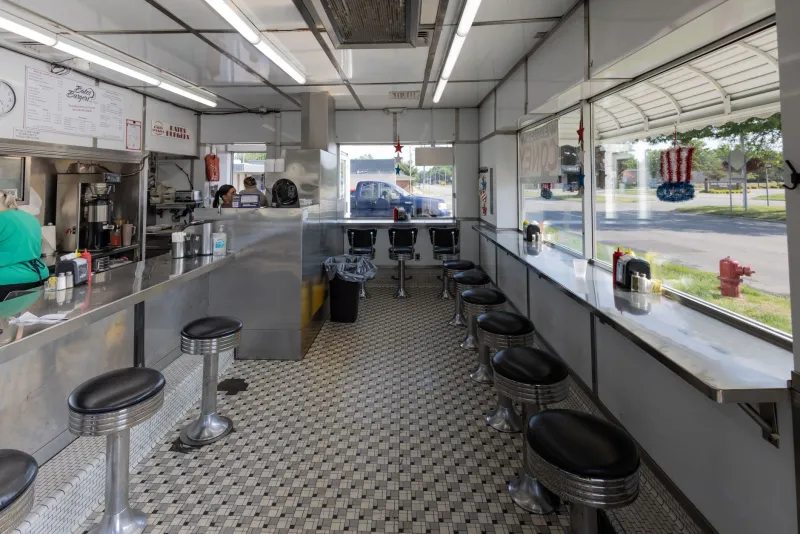
 Photo: New York, via theplanetd.com
Who Built This Language?
The honest answer is: a lot of different people, in a lot of different places, over a long stretch of time.
The American diner and lunch counter boom really hit its stride in the late 1800s and accelerated through the early 20th century. Urban lunch counters fed factory workers, office clerks, and anyone who couldn't go home for the midday meal. The workers behind those counters came from everywhere — recent immigrants, Black Americans who found kitchen work when other industries were closed to them, working-class white cooks from every corner of the country.
That diversity showed up in the slang. Regional variations were real and sometimes hilarious. A "blonde with sand" in one city meant coffee with cream and sugar. In another diner three states away, the same order might be called something completely different. There was no central authority, no training manual, no standardization committee. The language lived in the mouths of the people using it, and it mutated accordingly.
Some food historians trace strands of diner slang back to earlier American working-class vernaculars — the colorful shorthand of railroad crews, the coded language of military mess halls, the street talk of urban markets. It wasn't invented from scratch; it grew from a rich soil of American working culture that rarely gets much scholarly attention.
Why It Worked So Well
Beyond the entertainment value, diner slang was a genuinely sophisticated communication system.
For one thing, it was memorable in a way that flat, literal language isn't. "Adam and Eve on a raft" sticks in your brain. "Two poached eggs on toast" does not. The vivid, slightly absurd imagery made orders easier to hold in working memory during a chaotic rush — a real cognitive advantage in a high-speed environment.
It also created a natural quality check. When an experienced cook heard an order called out in proper slang, they could instantly flag inconsistencies or impossible combinations. The shared vocabulary created shared standards.
And it was fast. A single phrase compressed multiple pieces of information — the item, the preparation style, the modifications — into a compact, shoutable unit. It was, in modern terms, a remarkably efficient data compression system built entirely out of creative wordplay.
The Corporate Takeover That Silenced the Kitchen
The decline of diner slang tracks almost perfectly with the rise of corporate fast food chains through the 1950s, 60s, and 70s.
Chains like McDonald's, Burger King, and their competitors brought something the independent lunch counter never had: standardization. Printed order tickets. Numbered menu items. Later, computerized point-of-sale systems that translated customer orders into kitchen instructions automatically. The idiosyncratic, human, slightly chaotic verbal culture of the short-order kitchen had no place in a system engineered for interchangeable workers and identical outputs.
The independent diners that kept the tradition alive gradually thinned out. The generation of cooks who grew up speaking the language retired. Younger kitchen workers entering the industry learned corporate systems, not counter slang.
A few pockets held on. Some old-school diners in the Northeast and Midwest still have counter staff who know fragments of the old code, deployed more as nostalgia performance than functional necessity. Food historians and language enthusiasts have documented surviving terms. But as a living, working kitchen language? It's effectively gone.
What Got Lost
What disappeared wasn't just a quirky set of phrases. It was an entire mode of workplace culture — one built on creativity, shared identity, and the kind of informal mastery that comes from years of doing a difficult job alongside people who take it seriously.
The lunch counter cook who could rattle off a full order in flawless slang while managing four things on the grill simultaneously was demonstrating a kind of professional fluency that deserved more respect than it got. The language they built was genuinely theirs — made by workers, for workers, in the middle of the American workday.
Somewhere between the golden arches and the kitchen display screen, we lost something that was actually kind of wonderful. And most of us never even noticed it was there.