Punk Rock Pantries: The Scrappy Underground Movement That Quietly Saved Home Canning
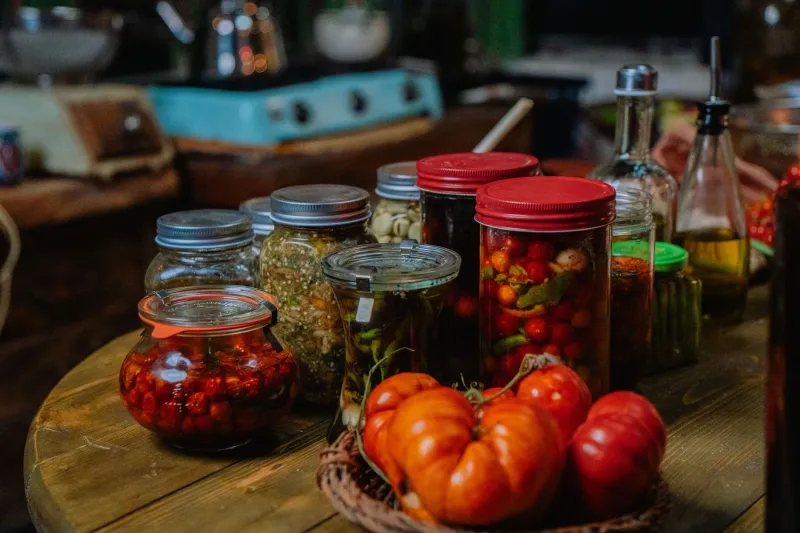
The image most people carry around of home canning is pretty specific: a farmhouse kitchen, sunlight through gingham curtains, a grandmother in an apron pressing lids onto Ball jars with the practiced confidence of someone who's done it a thousand times. It's a warm image. It's also, for the most part, a marketing image — one that obscures a much stranger and more interesting story about how home food preservation actually survived into the twenty-first century.
Because before the farmhouse aesthetic, before the homesteading revival, before canning became a cottage industry of cookbooks and YouTube tutorials, there was a completely different group of people keeping the practice alive. They weren't grandmothers. They were young women in alternative communities, operating out of punk houses and collective kitchens in cities like Portland, Minneapolis, and Olympia, Washington. And the tools they used weren't heirloom recipes — they were photocopied zines and the accumulated knowledge of people who were figuring things out as they went.
The Gap That Nobody Talks About
Here's the historical context that tends to get skipped. Home canning peaked in the United States during World War II, when Victory Garden campaigns encouraged American households to preserve their own food as a patriotic act. After the war, commercial food processing expanded rapidly, supermarkets proliferated, and home preservation declined sharply. By the 1960s and 70s, canning was increasingly seen as a relic — something your grandmother did because she had to, not something a modern person would choose.
The back-to-the-land movement of the early 1970s brought a brief revival, but it was largely concentrated in rural communities and faded as the decade ended. By the early 1980s, home canning had genuinely contracted to a small minority of practitioners, and most of the institutional knowledge — the USDA extension service pamphlets, the county fair canning competitions, the neighbor who knew what she was doing — was aging out of accessibility.
Something needed to bridge the Depression-era knowledge and the contemporary food culture that would eventually embrace it. That bridge, it turns out, was built by people whose food politics were a lot more complicated than 'I want to eat local.'
Radical Food Politics and the Canning Jar
The women who drove the 1980s underground canning movement weren't primarily motivated by nostalgia or self-sufficiency as an aesthetic. They were motivated by politics.
The alternative communities that formed around punk and post-punk culture in American cities during the early 1980s were deeply skeptical of corporate food systems. Processed food wasn't just unhealthy — it was, in their framing, a mechanism of control. Industrial agriculture, food additives, and the homogenization of American eating were things to resist, not accept. Canning your own food was, in this context, an act of refusal as much as it was a practical skill.
This political framing attracted a different kind of practitioner than the homesteading movement had. These weren't people moving to rural Oregon to get off the grid. They were people living in cramped urban apartments, working part-time jobs, and trying to eat well on almost no money while refusing to fund the food corporations they distrusted. Canning was affordable. It was scalable. And it was something you could do in a collective kitchen with five other people on a Saturday afternoon.
The collective kitchen model was central to how this movement spread. Houses that operated communally — sharing cooking duties, grocery costs, and food storage — became informal training grounds. Someone who had learned to can tomatoes from an old USDA pamphlet would teach three housemates. Those housemates would move to new cities and teach others. The knowledge moved through social networks rather than through formal instruction.
Zines as Instruction Manuals
The publication format that held all of this together was the zine — the hand-assembled, photocopied, stapled-at-the-corner publication that was the primary medium of alternative culture communication before the internet.
Food zines from this era are genuinely fascinating documents. They mixed canning tutorials with political essays, recipe swaps with rants about food deserts, practical preservation advice with poetry. Titles like Soy Not Oi! (a vegetarian punk zine that included food preservation content) and dozens of unnamed, locally circulated kitchen zines carried detailed instructions for water-bath canning, fermentation, and pickling alongside the kind of editorial voice that no mainstream food publication would have touched.
These zines did something important: they translated the dense, cautious language of official canning guides into accessible, conversational instruction. USDA preservation guidelines, which had been updated significantly in the 1970s and 80s as food safety research advanced, were often written in bureaucratic language that intimidated new practitioners. The zine writers rendered the same information in plain English, with the specific additions of 'here's what we actually do' and 'here's what happened when we tried it.'
The safety dimension is worth noting. One of the persistent myths about this era of DIY food culture is that it was reckless — that people were botulism risks waiting to happen. The reality is more nuanced. The communities that were most serious about canning were also most serious about food safety, because they understood that a mistake could hurt people they cared about. The zines that circulated preservation techniques were careful about safety information, often more so than the romanticized 'just do what grandma did' approach that circulates in some contemporary canning circles.
The Bridge to Now
By the mid-1990s, the underground canning movement had quietly seeded a broader revival. Women who had learned to preserve food in collective punk houses in 1984 were now in their thirties, some of them running farmers market stalls, some of them teaching canning workshops at food co-ops, some of them writing the early food blogs that would eventually become the instruction layer for a whole new generation of home preservers.
When the mainstream canning revival hit in the late 2000s — driven by the local food movement, the recession economy, and the rise of food blogs — it landed in soil that had already been prepared. The techniques, the safety knowledge, the accessible instructional voice: all of it had been developed and refined over two decades by people who never got a cookbook deal or a magazine spread.
Martha Stewart published her first canning-focused content in the mid-1990s, and the farmhouse aesthetic gradually became the dominant image of home preservation. It's a fine aesthetic. But it's worth knowing that while that image was being constructed, a completely different group of people had already been doing the actual work for years — in apartments that smelled like vinegar, with secondhand equipment, and with a copy of someone's photocopied zine propped against the backsplash.
The mason jar didn't get rescued by nostalgia. It got rescued by people who were angry about the food system and willing to spend their Saturday boiling lids about it.